"publishing is entering its netflix moment"
Gelato CEO Henrik Müller-Hansen on redefining global publishing
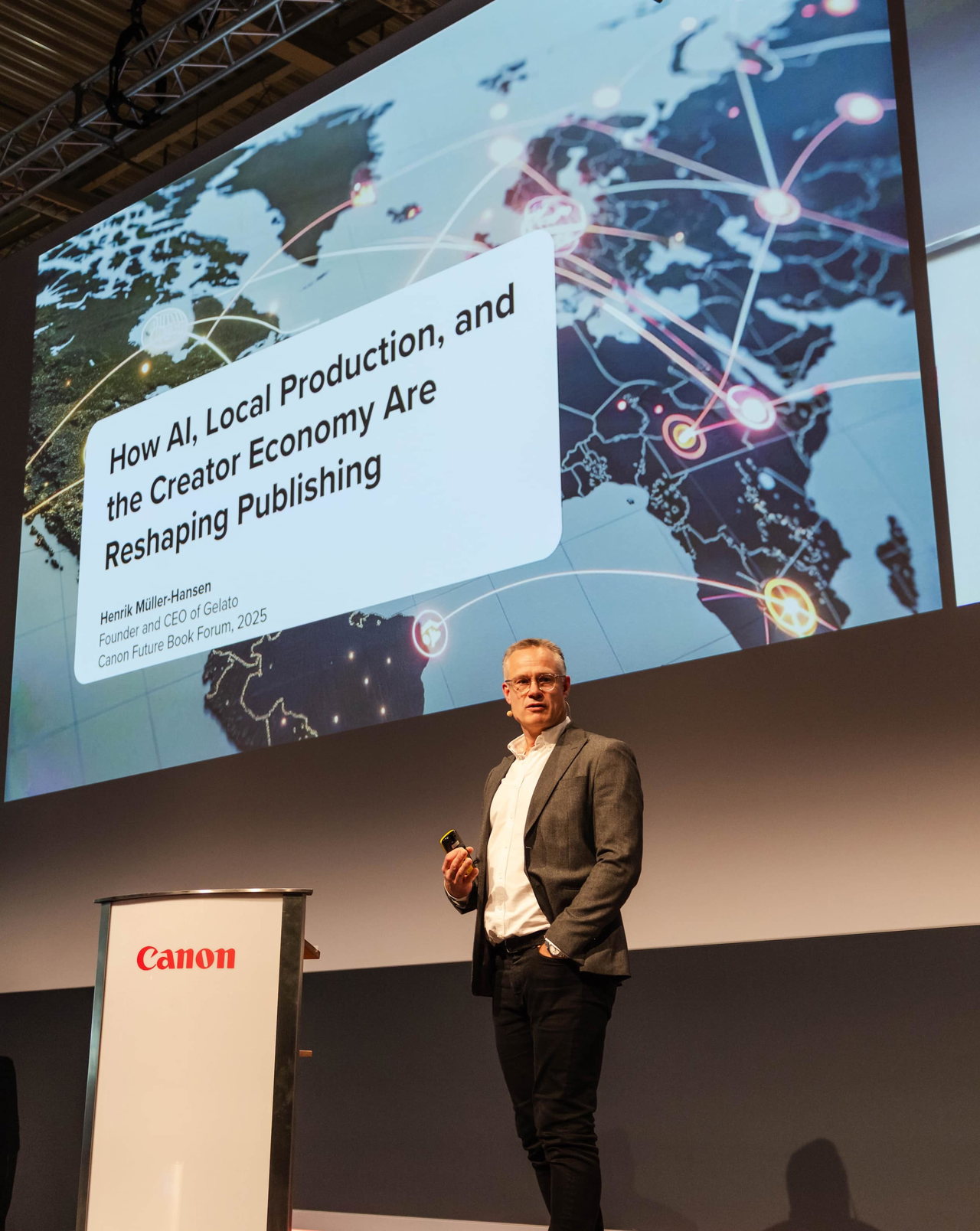
"The biggest challenge isn't technology — it's mindset," says Henrik Müller-Hansen, founder and CEO of Gelato (Website), the global production-on-demand platform. In this interview, the speaker of the 2025 Future Book Forum of Canon explains why the century-old model of centralized mass production, long print runs, and warehouse inventory is giving way to a new paradigm: networked intelligence, local manufacturing, and zero-inventory operations.
Drawing on Gelato's operations across more than 30 countries, he demonstrates how AI-powered infrastructure is leveling the playing field between publishing giants and independent creators, making backlists evergreen and niche titles viable for the first time. Müller-Hansen outlines his vision for 2030, where every print run is triggered by real demand, optimized by artificial intelligence, and produced locally — transforming publishing from a static industry into a living, learning ecosystem.
His ultimate goal is way beyond publishing: redefining global manufacturing so that mega cities produce what mega cities consume, bringing production closer to customers while making it faster, smarter, and greener.
“The future of production must be local, on-demand, and zero-inventory,” you once said. What are currently the biggest challenges on this journey?
Henrik Müller-Hansen: The biggest challenge isn’t technology — it’s mindset. For over a century, publishing and manufacturing have optimized for scale: long print runs, centralized production, and global logistics. That model made sense when speed and data were limited. But in a connected, real-time world, the hidden costs of that model — idle inventory, long transport routes, and waste — are destroying both margin and sustainability.
The shift now required is from industrial efficiency to networked intelligence. AI and software can already connect demand and production locally, instantly, and profitably. The real work lies in leadership: in replacing prediction with responsiveness, and seeing intelligence, not inventory, as the new driver of efficiency.
"The biggest challenge isn’t technology — it’s mindset"
What new products and business models are made possible by your platform and your focus on digital (book) printing?
Digital printing has rewritten the economics of publishing. A publisher no longer needs to print 5000 copies and hope they sell. They can now print a single copy profitably, anywhere in the world, the moment demand appears.
This turns the book lifecycle upside down: backlists become evergreen, niche titles viable, and creators can reach readers globally without inventory or risk. In many ways, publishing is entering its Netflix or Spotify moment — where data, personalization, and instant availability reshape what’s possible.
The Western book market shows both a revival of print and a decline in sustainability focus. How are you navigating that?
The revival of print, especially among Gen Z, is emotional: readers value something tangible, lasting. But emotion and responsibility can coexist.
Local, on-demand production makes print more sustainable by design. Printing near the reader eliminates overproduction, reduces emissions, and protects margin. Sustainability isn’t a marketing claim anymore; it’s a more profitable operating model.
Amazon, Spotify, and others are merging media formats. What will the future of media platforms look like — and how will print and digital intertwine?
The separation between digital and physical will dissolve. A story might begin as a podcast, grow into a community, and culminate in a printed collector’s edition.
Future platforms won’t think in formats; they’ll think in ecosystems. Print will be one of several expressions of a single creative process, personalized through data and AI. That’s why Gelato isn’t a print company; it’s a production cloud where any creative idea can materialize locally, on demand, in any form.
What role does AI play in bridging these worlds inside Gelato’s ecosystem?
AI is the connective tissue between digital and physical creation. It automates what used to be manual — everything from pricing and procurement to workflow optimization and logistics.
In GelatoConnect, AI continuously learns from millions of micro-orders to improve cost estimation, production routing, and delivery. The result is fewer errors, faster turnaround, and higher profitability.
Our vision for AI is not theater; it’s infrastructure. Invisible, scalable, and transformative. AI turns complexity into clarity, and information into intelligence.
"The most successful publishers will be those who act globally but produce locally"
The book industry is traditionally local, tied to licensing systems. How will that change as Gelato enables global reach?
Licensing will evolve from fixed territories to flexible access models. When production is local everywhere, global reach becomes frictionless. A German publisher can test demand for an English edition in Singapore or São Paulo instantly, without printing or shipping upfront.
We’re already working with multinational publishers who use Gelato to manage one global catalog, printed locally. It’s not globalization replacing local culture; it’s local culture amplified through intelligent distribution.
What tools and skills are needed to balance global scale with local authenticity?
Two things: data literacy and local empathy. Data enables visibility across a global network; local empathy ensures relevance and trust.
That’s exactly what Gelato enables — real-time analytics paired with local production hubs. The most successful publishers will be those who act globally but produce locally, seeing the world not as a hierarchy but as a network.
How do you see the rise of self-publishers and creators using Gelato? Are they innovation hubs publishers should watch?
Absolutely. The creator economy — now worth more than $500 billion — is where the next generation of stories emerges.
Creators are the R&D labs of publishing: they experiment faster, understand their audiences intimately, and move from idea to product in days. With GelatoCreate, they can publish globally with no inventory, no upfront cost, and full creative control.
Publishers that collaborate with creators, rather than compete with them, will unlock entirely new markets and readerships.
How does Gelato help smaller publishers compete with global giants?
By giving them the same technology stack. Gelato levels the playing field. Local printers, small publishers, and solo creators all access the same AI-powered infrastructure as global enterprises.
In the old world, scale required capital. In the new world, scale is software.
On-demand production assumes readers already know what to ask for. How do we solve discoverability in this crowded landscape?
Discoverability today is driven by algorithms. Most optimize for attention, not depth. AI can change that.
By enriching metadata, connecting communities, and personalizing discovery, AI can help readers find books that matter, not just those that trend. The future of publishing isn’t just producing smarter; it’s discovering smarter.
What will the book ecosystem look like in 2030?
By 2030, publishing will be fully connected, from idea to production to delivery. Every print run will be triggered by real demand, optimized by AI, and produced locally.
We’ll move from inventory-based publishing to intelligence-based publishing — faster, cleaner, and infinitely more adaptable. The winners will be those who treat publishing not as a static industry, but as a living, learning ecosystem.
What is your long-term vision for the world’s production cloud?
Mega cities should produce what mega cities consume. That is the inevitable and advantageous outcome of the rapid evolution of production technology, now accelerated by AI. As production capabilities become more localized, intelligent, and automated, the logic of global trade is being rewritten.
Our aim is to transform the way the world produces. We’re doing that by building a single, intelligent network that’s powering local, on-demand production for global commerce.
This isn’t just about books or print; it’s about transforming how all products are made and moved — closer to the customer, faster, smarter, and greener.
The ultimate goal: to redefine global manufacturing for people and planet, where creativity scales sustainably and technology amplifies human potential.
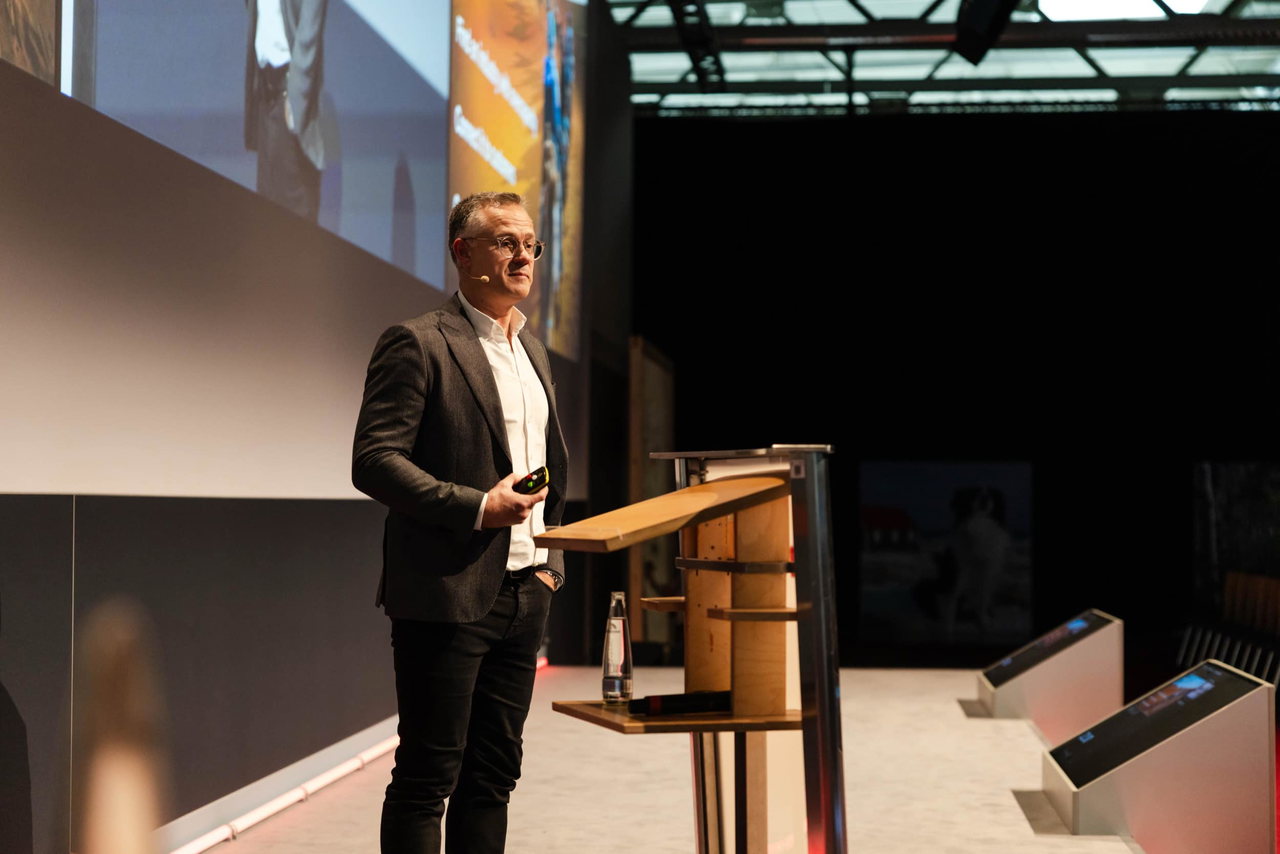
Henrik Müller-Hansen is founder and CEO of Gelato (Website). Henrik leads a global production on demand software platform that is redefining manufacturing with its operations in over 30 countries. In 2021, Gelato raised $240m at over $1B in valuation.
Photos: Canon