"where can i work with others within my industry?"
Julian Kawohl on how to build a sustainable publishing ecosystem
A failed insurance project, over 1,000 conversations with managers, and the realization that the economy is undergoing fundamental change: Julian Kawohl has taken an unusual path from corporate strategy to academia. Today, he teaches as a professor how business ecosystems work – and where they fail.
In conversation, he takes a close look at various industries, from agriculture to AI to publishing. One conclusion: caught between tradition and transformation, publishers face a choice: either develop boldly curated, integrated solutions or disappear as interchangeable suppliers on the big tech platforms.
Your journey into the world of business ecosystems began, of all places, with a failed ecosystem in the insurance industry. You wanted to combine smart home devices with insurance products and failed?
It was actually a very interesting project. I was head of strategy at AXA at the time, and the aim was to take the first steps toward business outside of insurance in 2009 or 2010. At that time, there was the first major wave of smart homes, and RWE Energy, now merged with E.ON, was one of the pioneers in the smart home sector.
We had connections at the executive board level and got together without all the structures we have today. The idea was that there is a connection—insurance insures a house, and smart homes provide security against burglary. The idea was that insurance costs would go down because there would be less damage and fewer burglaries, and smart home sales would go up because AXA had access to customers through its insurance customers. In the end, it was a win-win-win for the customer, for RWE Energy, and for the insurance company.
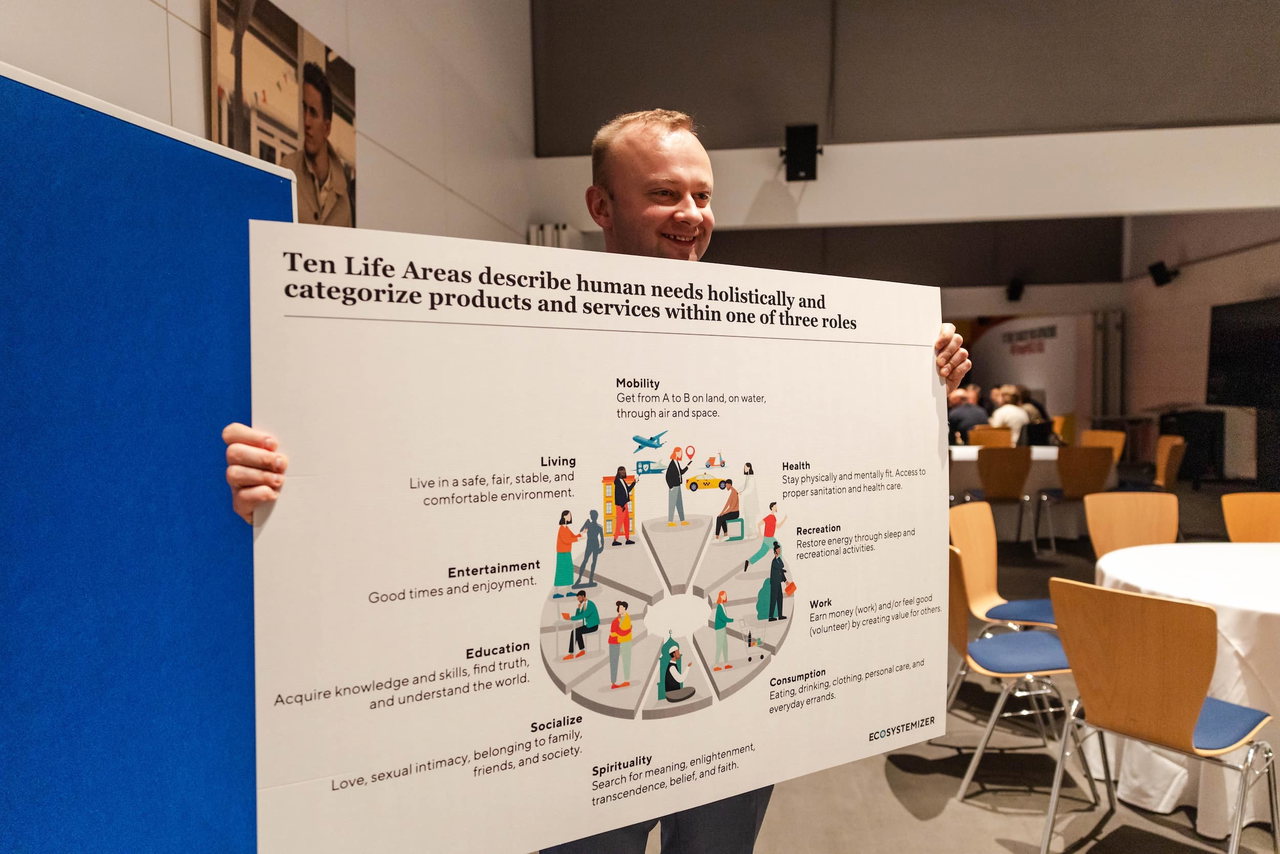
Identifying opportunities in the business ecosystem with the "Ecosystemizer"
Sounds reasonable, so why did it fail?
The mindset of AXA's sales team. The salespeople said: It's already incredibly difficult to sell insurance products. And now I have to explain to my customers that they also need to install a smart home box with an alarm system, light detectors, and other features. I'd rather not. In the end, the traction rate and sales were too low.
"I not only immersed myself in the world of collaboration and ecosystems, but also actively tried to help shape it"
How did you get into science then?
I thought to myself: How can I delve deeper into the topics that interest me? And above all, how can I get to know other industries? So I started doing very practice-oriented research and spoke to over 1,000 managers in the following years. My key questions were: How are business models changing? How are operating models changing? So I not only immersed myself in the world of collaboration and ecosystems, but also actively tried to help shape it.
Was there a particular moment when you realized that ecosystem business was the topic that much of the economy was likely to evolve toward?
Actually, it was at a conference called "The Digital City" in Düsseldorf, an initiative of Vodafone and various companies in Düsseldorf, including the city itself.
At one of these conferences, I met someone from RWTH Aachen University, Dennis Krechting, who would later become my co-author. He was researching networks from a B2B perspective in Aachen. I, on the other hand, came more from the end customer and B2C side. We then said: Let's bring this together. That's how we came up with the initial idea of how to develop frameworks to make this elusive topic more tangible.
"Where do companies create value in people's lives, regardless of whether they approach from a B2B side or a traditional consumer side with an ecosystem?"
You then came up with the bold thesis that in ten years' time, we will no longer be talking about B2B or B2C, but about ecosystems that serve people.
Bold theories are always meant to be provocative. Scientifically, one might ask: How do you actually measure that? Is it a question of results or rather how people talk about it? Companies make this distinction because it allows them to quickly classify themselves: friend, foe, demarcation of territories, industries, traditional markets. Ecosystems, on the other hand, do not distinguish between B2B and B2C. "Ecosystem to Human" means that we consider: Where do companies create value in people's lives, regardless of whether they approach from a B2B side or a traditional consumer side with an ecosystem? Ultimately, it's about problem solving, about needs that I satisfy as a company.

From guitar manufacturer to creative ecosystem: Fender
How far has this development progressed?
Definitely not as far as I once casually predicted, but definitely on a path that I believe is already irreversible. The question then becomes: Are companies that do not integrate this mindset in danger of getting bogged down in the old world?
Are there any industries that are particularly advanced on this path?
The younger industries and companies – Apple, NVIDIA, the entire AI industry, the tech industry, software players such as SAP – think very strongly in terms of ecosystems in their sales activities with all their partners and service providers. They have this mindset much more deeply embedded in their DNA.
Are there any hidden champions in this area?
Absolutely, for example in agriculture. There, the aim is to optimize crop yields in the field – and not primarily to sell tractors or seeds. We had a project with a fertilizer manufacturer. With fertilizers, it's all about price. The fertilizer manufacturer asked itself: How can we create services to grow if we don't want to compete solely on price? The conclusion: We need to get closer to the problems faced by farmers. For example, we need to help alleviate the drought in Spain and France.
This way of thinking already exists in agriculture – among those who manufacture fertilizers or agricultural machinery and spare parts, or who provide logistics.
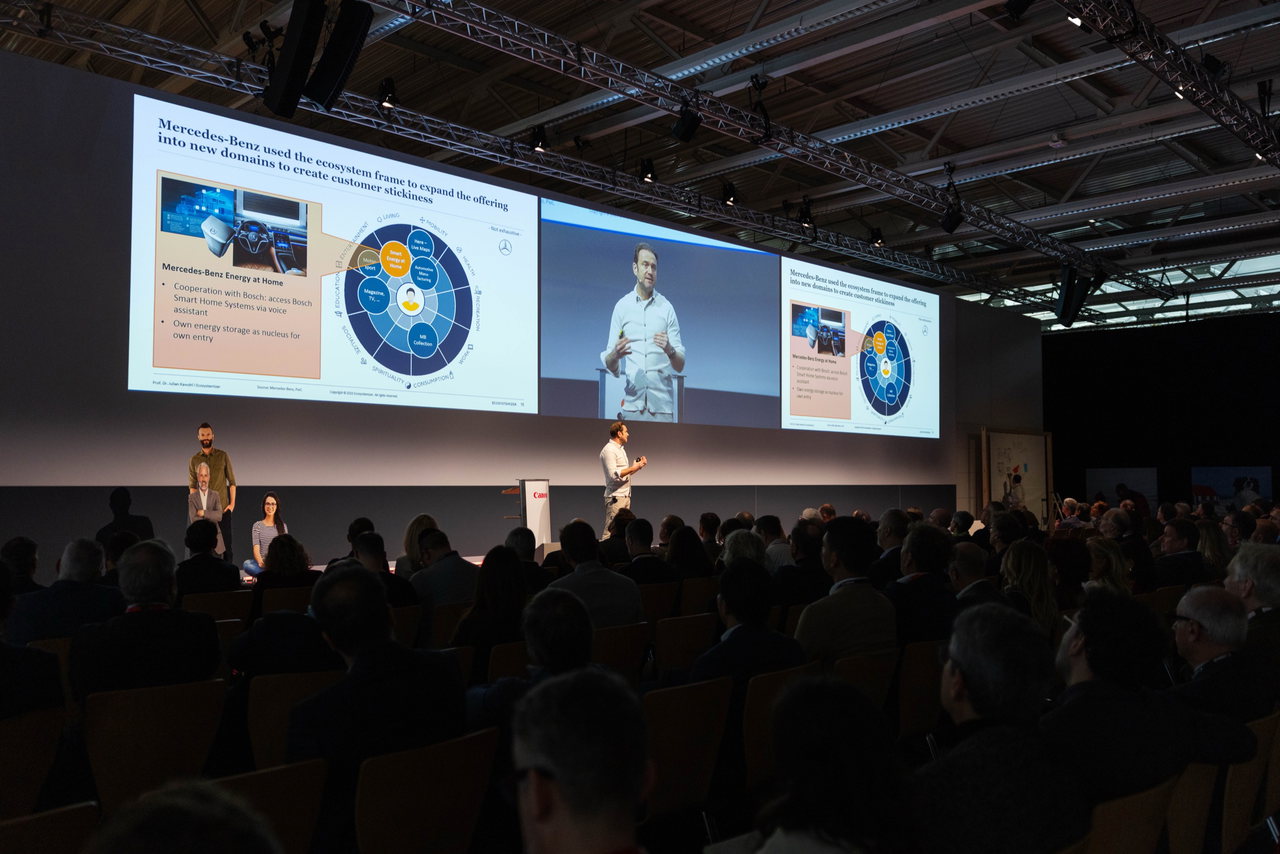
In the automotive industry, even the German players were once leaders when it came to ecosystems. Seven to ten years ago, Mercedes, BMW, and Volkswagen were very actively considering how to develop the connected car. Mercedes even turned it into a slogan: "CASE" stood for Connected, Autonomous, Shared, Electric. They tried to connect different areas beyond the car to create a customer experience. Then they stumbled back several steps, focused on luxury at Mercedes, missed the boat on electric, and are now trying to catch up again – so they left the field to the Chinese players.
Take NIO, for example. I spoke with the head of NIO Europe here in Munich at the IAA. He said: We will never be able to build cars as well as Mercedes or BMW, but we can create the experience around them. We are building our brand, which has to be present everywhere. We build smartphones, we build apartments, and we try to create digital experiences. I don't know if it will work, but I'm doing it differently because I could never go the normal route.
BYD now sells more cars than Tesla and sees itself as the smartphone on wheels – something that Herbert Diess, former CEO of Volkswagen once promoted but was never able to realize himself.
"If you can't sit out certain things and can't just cut costs, then you have opportunities to bring new things into the company that go beyond product improvement"
Does the rule also apply in your field of research: the more pressure an industry is under, the more open it is to ecosystems – because it knows that we can't do it alone?
Yes, I think so. This applies even more at the individual company level. If you can't sit out certain things and can't just cut costs, then you have opportunities to bring new things into the company that go beyond product improvement. Then, of course, you still need the people who will actually do it. But the danger is always that the contract terms for board members are two to three, maximum five years. And there is often no tradition of initiating sustainable transformation changes that take longer. Instead, the tendency is to push certain flagship projects.
A good example of the opposite is the Schwarz Group with Lidl and all its other projects. There you have an owner – coincidentally the richest man in Germany – who thinks very long-term, who values education, who understands technologies such as AI and who says: I don't just want to preserve my company, I want to make an impact, for myself but also for others. Then he takes an ecosystemic approach to business models: in AI, in the cloud, in recycling, in logistics, in order to build future pillars alongside the retail business, to fuel his own and also to create something good for Germany.
How NVIDIA shapes its ecosystem
You also cite the AI industry as a prototype for successful ecosystems. However, in your opinion, sustainability also plays an important role there. How does that fit together, considering the amount of electricity consumed to run AI services?
That's a valid question. Until now, sustainability has been thought of too much in terms of what is required by regulation: CO2-free production, a completely CO2-free supply chain. If I only look at the current situation and the figures, you could say that it's a bad industry. However, from an ecosystem perspective, the opportunities offered by sustainability amount to a bet on the future, based on the motto: if the magic of innovation comes, it will be worth having invested in bad energy in the first place. Because at some point, applications and processes will follow with the help of AI that will ensure greater sustainability overall.
In addition, data centers must increasingly be powered by green and sustainable electricity. We are not there yet, but the trend is moving in that direction. We are now in a transitional period: we cannot or do not want to do without one thing, but at the same time we have to work on the transformation.
"I believe the trick is to think much bigger: What human problems can you solve?"
How far has ecosystem thinking already progressed in the publishing and media industries today?
We are only at the beginning. Today's products look much the same as they did 20, 30, or 50 years ago, albeit with attempts to create digital content derived from them – but very much as a continuation of the same or a replacement of similar content in a digital format.
I believe the trick is to think much bigger: What human problems can you solve? Which fields are interesting? Who are the partners? What content and business models are then possible? There are some interesting approaches, after all. Scientific publishers such as Pearson are developing blended learning content, trying to create tutorials, and investing heavily in education.
From my point of view, the platform concept tends to prevail here: customers are lured to a platform and enticed with various content formats. How does this become an ecosystem?
By publishers delving deeper into individual customer journeys, age groups, and specific categories of needs. The aim is to integrate the offerings deeply into customers' lives, according to the motto: if you want to familiarize yourself with a particular industry, you get your package of all these things, curated by us. We provide you with experiences that help you achieve your goals very quickly in specific contexts, whether business or private. Then it really becomes ecosystemic. Of course, the first step is investment and effort.

Adidas: "Selling shoes without selling shoes"
Specifically, how would Pearson's education platform become an ecosystem?
If Lufthansa were to offer Pearson's learning courses in business class via its own board system and share revenue with Pearson. Airbus is actually trying something similar: going beyond the hardware – we sell machines to airlines – and thinking: How can I create in-flight business models? They have created a platform where start-ups can bring their services onto the plane.
The undertaking is not easy because when I sell an aircraft, it brings in $300 million. When I sell a service like this, it's a few thousand at the beginning. However, in addition to direct monetization, long-term loyalty through such integrated offerings—also known as the lock-in effect—is an important success factor and argument in favor of such ecosystem approaches.
In the media industry, it is the big American companies that have built the big platforms. What can a European or German publisher do to avoid simply becoming a supplier for Google, Amazon, or Apple?
I have two strategies. Either I have to make sure that I do something good for the big platform players that no one else can do – something without which they could quickly replace me. Specifically, I have to consider: What services can I provide to improve their business? To do this, I need to understand their business and also know where they are headed. I may not be on an equal footing in terms of financial strength, but perhaps in terms of my domain knowledge or my ecosystem thinking compared to other players who simply say: I'm just one supplier among many.
The other approach is: I ask myself: Where can I build something with others within my industry or my domain that the big US companies can't do because they take too generic a view?
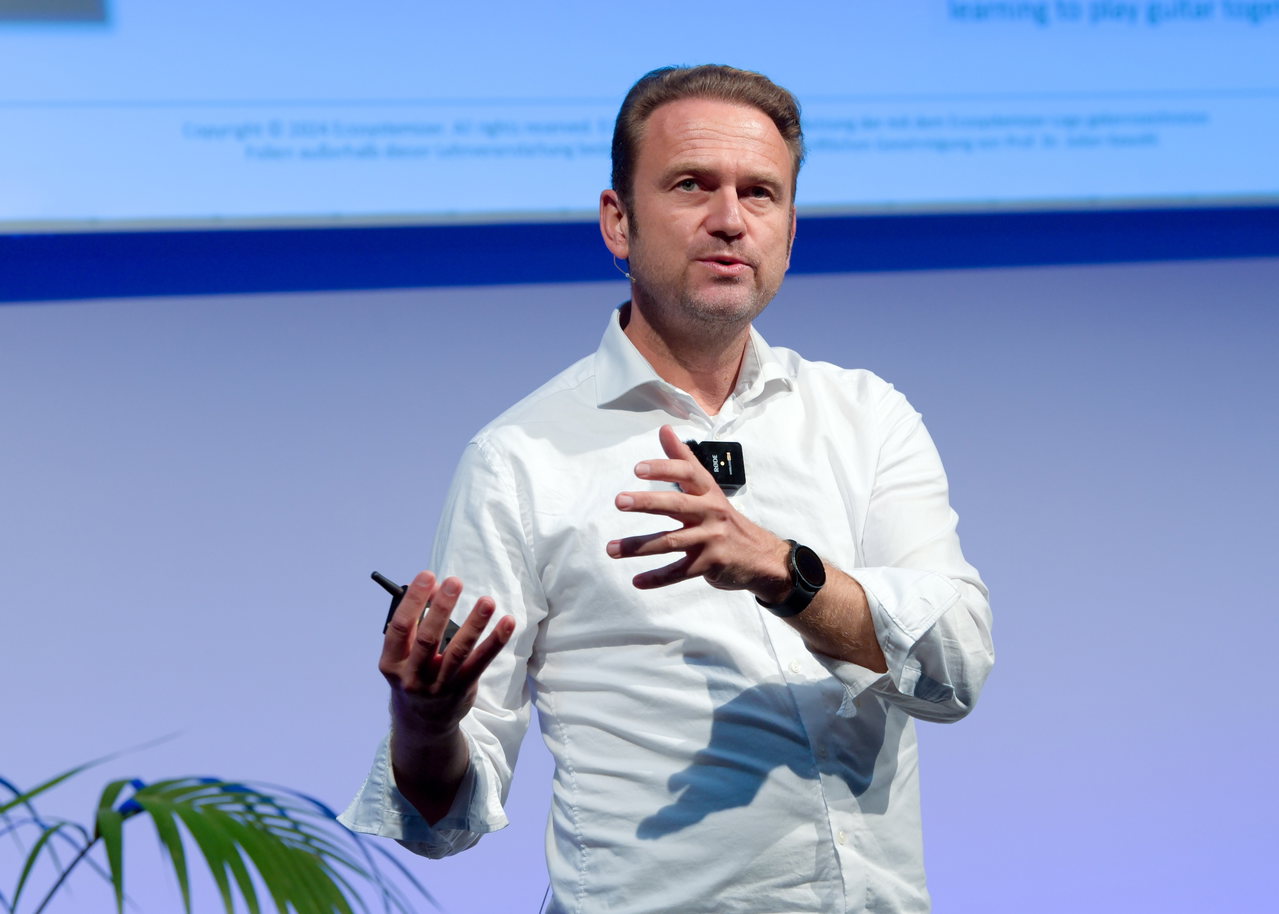
Prof. Dr. Julian Kawohl is the founder and CEO of Ecosystemizer and has been a professor of strategic management at the Berlin University of Applied Sciences since 2015. Previously, he was head of strategy at AXA Germany, a subsidiary of a French insurance company listed on the EURO STOXX 50. In his role as a thought leader, he is an author, keynote speaker, and senior advisor to companies in various industries with a focus on future strategies, digital transformation and ecosystems.