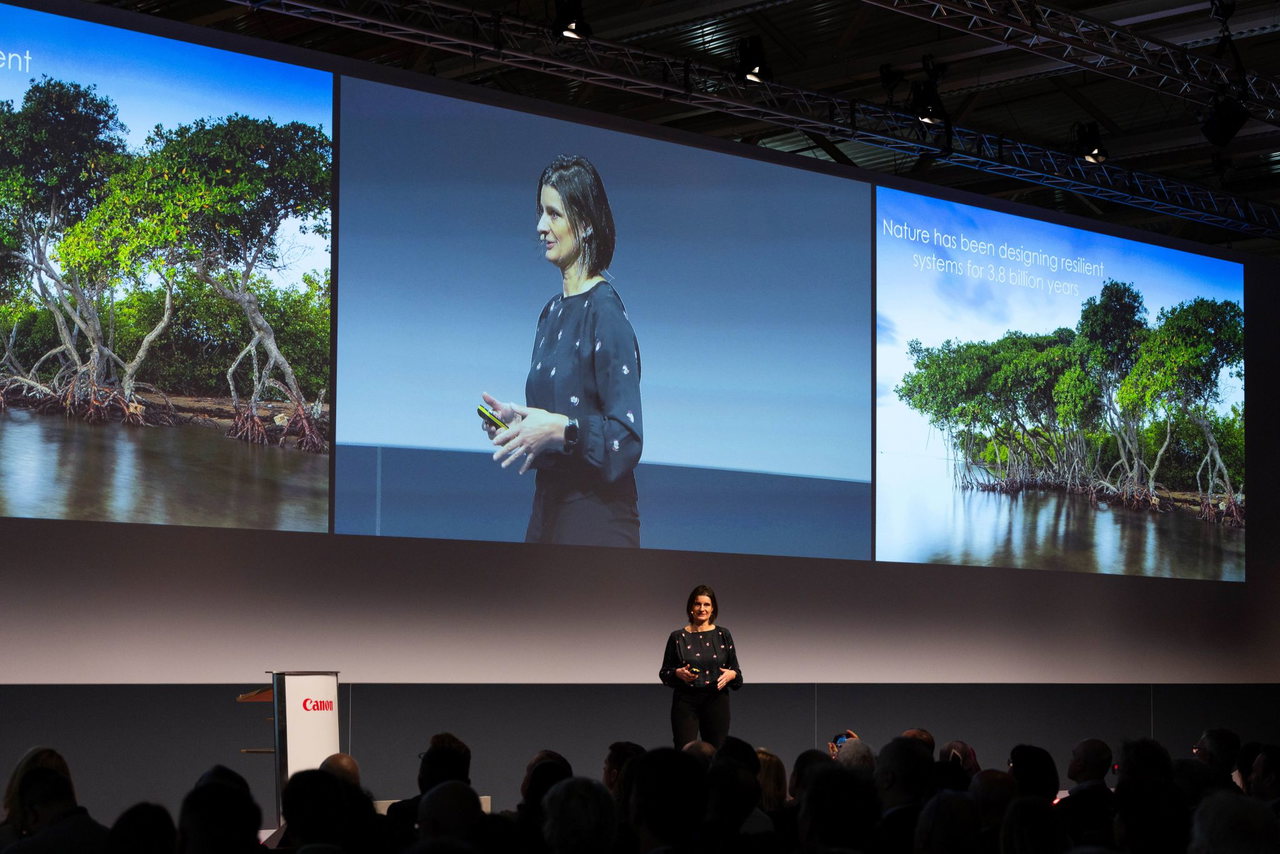
"what would nature do?"
Saskia van den Muijsenberg on biomimicry as an innovation model for publishers
How can publishers and media companies learn from 3.8 billion years of natural evolution? Saskia van den Muijsenberg, expert in biomimicry and nature-inspired innovation, explains in this interview why the answers to many business challenges already exist in nature – tested, refined, and surprisingly applicable to business models.
From closed loops instead of linear growth, symbiotic partnerships, to decentralized diversity as a resilience factor: Van den Muijsenberg, speaker of the 2025 Future Book Forum of Canon, demonstrates how natural principles can be concretely applied in the media and publishing industry.
What inspired you to deal with the principles of biomimicry?
When I first came across the concept of biomimicry, it felt like coming home. The idea that the solutions to so many of our human challenges already exist in nature, tested and refined over 3.8 billion years, was deeply moving. Growing up by the sea, I was always aware of the intelligence in natural patterns: tides, seasons, the balance of ecosystems. Later, working in large organisations, I realised how often we design against nature’s logic rather than with it. When I discovered biomimicry, it brought together my fascination for innovation, systems thinking, and purpose. It showed me that innovation doesn’t have to mean invention; it can mean remembering how nature already solves problems beautifully, and life-friendly at the systems level.
What are the key principles of a nature-inspired business ecosystem, and how do they differ from traditional economic models?
A nature-inspired business ecosystem works to create conditions conducive to life. It’s about designing organisations that are adaptive, regenerative, and deeply connected to their context. In nature, systems operate in closed loops: there is no waste, only nutrients cycling through networks of cooperation and feedback. The key principles include being locally attuned and responsive, optimising rather than maximising, building resilience through diversity, and integrating development with growth.
Traditional economic models tend to separate humans from nature, prioritising extraction and linear growth. Nature-inspired models see business as part of a living system—where success means thriving together with the environment and community. They focus on circular resource flows, shared value, and relationships that strengthen the system as a whole.
"Biomimicry applied not just to products, but to culture, systems, and purpose"
Can you give a specific example of how a company has undergone holistic change by imitating natural processes?
Interface, a global carpet manufacturer, is one of the most inspiring examples. In the 1990s, founder Ray Anderson realised the environmental impact of his company and set out to redesign it according to nature’s principles. Guided by biomimicry experts like Janine Benyus, Interface began asking a simple question: what would nature do?
Their product innovation started with the i² carpet system, inspired by the forest floor. Instead of making identical tiles, Interface designed each one slightly different (like leaves or patches of moss) so that they fit together in any direction. This eliminated waste, simplified installation, and created a more organic aesthetic. Then came TacTiles, inspired by the gecko’s feet, using van der Waals forces to attach tiles without glue. This reduced toxic emissions and made the carpets recyclable.
Perhaps most powerfully, Interface’s Net-Works™ program showed how business can function as part of a living ecosystem. Working with the Zoological Society of London, they collected discarded fishing nets from coastal communities, turning marine waste into recycled nylon yarn. This reduced ocean pollution, provided income for local people, and fed clean material back into Interface’s supply chain; a perfect closed loop. It mirrors how nature transforms waste into resources.
Interface is now producing carpet tiles that store more CO2 than they emit during manufacturing, and it has evolved its vision into ‘Project Positive’: redesigning their factory sites to perform like the natural ecosystem next door: cleaning air, managing water, and supporting biodiversity. It’s a profound example of biomimicry applied not just to products, but to culture, systems, and purpose.
"Nature shows us that healthy competition happens within cooperation"
Which patterns or principles of natural ecosystems could be especially transferred to cooperation and competition in the media and publishing industry?
Nature shows us that healthy competition happens within cooperation. In a forest, trees compete for light but share nutrients through fungal networks. In the same way, media and publishing companies can thrive by combining competition with collaboration—sharing infrastructure, data, and learning.
Several natural patterns are particularly relevant: diversity brings resilience; feedback loops enable rapid adaptation; and mutualistic networks (like coral reefs or mycorrhizal webs) show how partnerships can benefit the whole. Instead of a zero-sum race for attention, publishers could see themselves as part of a knowledge ecosystem, where different formats, voices, and platforms strengthen one another. These same dynamics apply directly to today’s information landscape. A nature-inspired media ecosystem values the strength of local roots and the fluidity of global connections. Smaller, niche publications can act like specialised species in a larger web; each one serving a unique purpose but all connected through shared data and collaboration. Healthy ecosystems self-regulate through feedback; in media, that means transparent metrics and responsive editorial processes. Diversity of content and decentralised production not only increase resilience but also build trust—because authenticity, like biodiversity, cannot be faked. In the same way that Interface moved from ‘doing less harm’ to actively regenerating ecosystems, publishers can evolve from passive information distributors to active ecosystem stewards who nurture knowledge, curiosity, and civic health.

Publishing 2030 Accelerator: driving sustainability by distributing print
The initiative focuses on scaling its global digital printing network to eliminate book overproduction and shipping.
"Innovation inspired by nature isn’t about doing less harm. It’s about creating conditions for ideas and communities to thrive"
What specific recommendations do you give to publishers and media companies to promote innovation and resilience with the help of natural principles?
First, map your ecosystem. Identify your key relationships (audiences, creators, platforms, advertisers) and understand how value flows between them. Like nature, healthy systems depend on balanced exchanges and feedback loops.
Second, close your loops. Reuse and repurpose content, share research and archives, and design workflows where nothing is wasted.
Third, diversify. Encourage different content types, voices, and partnerships. Biodiversity is nature’s insurance against disruption.
Fourth, build symbiotic alliances: collaborations where every partner gains strength, just as Interface did with its Net-Works and Project Positive initiatives. Fifth, measure success differently. Go beyond clicks or profits to track your positive impact: trust built, misinformation reduced, community engagement deepened.
Ultimately, innovation inspired by nature isn’t about doing less harm. It’s about creating conditions for ideas and communities to thrive. That’s how publishers can evolve into living, learning systems that regenerate the social and informational soil they depend on. For media organisations, this means building cultures of continuous learning, where curiosity and adaptability are embedded in every layer of the organisation. Experimentation should be safe and encouraged, much like nature’s constant prototyping through variation and selection. Investing in long-term relationships with audiences, educators, and communities builds resilience similar to the mutual dependencies found in natural ecosystems. Also, think spatially: just as forests connect underground through mycorrhizal networks, media ecosystems can connect through shared technology, open-source tools, and collaborative standards. And finally, lead with purpose. Nature has no chief executive; it thrives because every part understands its role within the whole. A publisher that aligns business goals with cultural and ecological well-being becomes more than a company; it becomes a living system that continually renews itself and contributes to the greater good.
Saskia van den Muijsenberg is one of Europe's leading biomimicry professionals. With a variety of Fortune 500 companies, she catalyses innovation by enabling others to explore life’s design strategies to develop new ideas into real business opportunities and value models.