“the book deserves better”
How a young print shop owner is reshaping book production through smart finishing and relentless networking
Published: 30.4.2026 | Foto / Video:
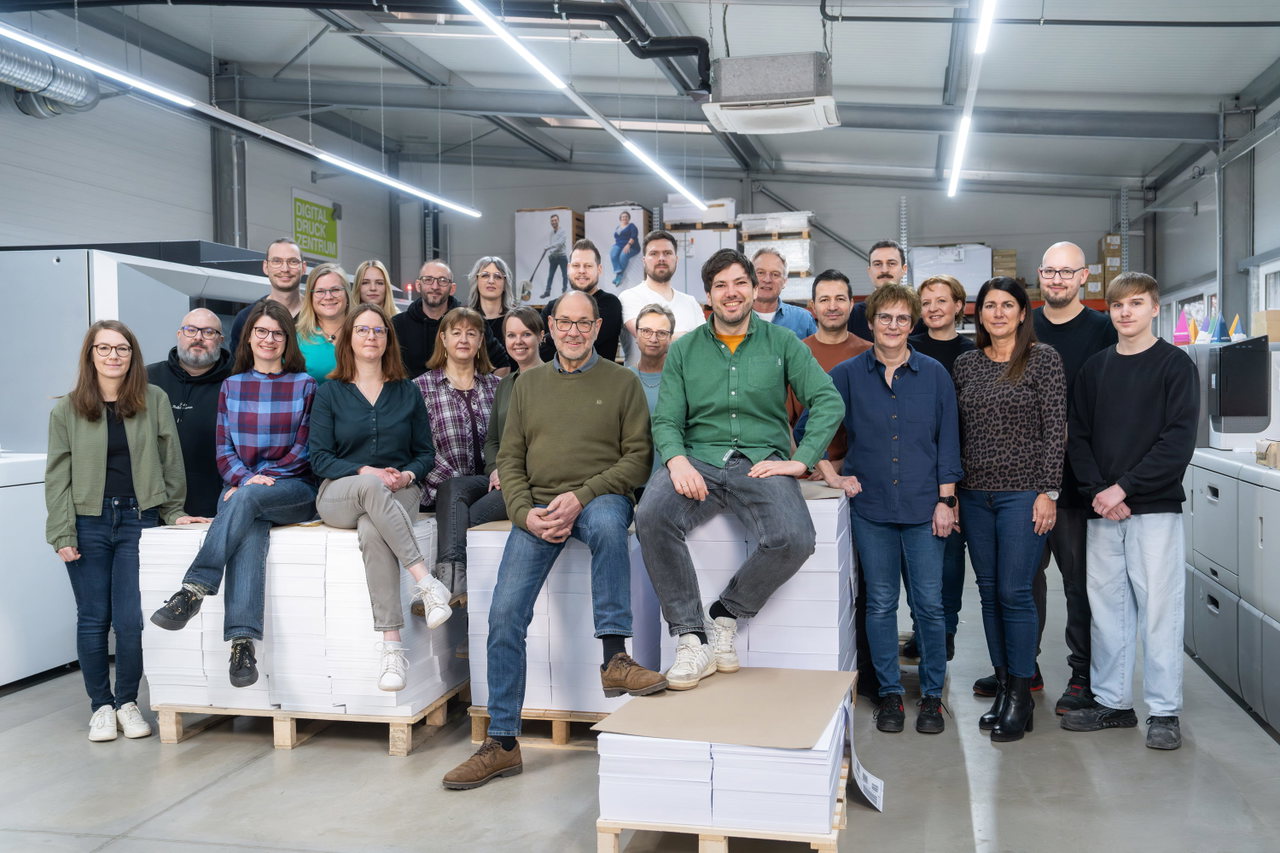
Walk into the world of traditional print shops and you step into a world of unspoken rules: Everyone knows everyone, but hardly anyone talks to anyone else. For decades, silence was the norm; openness was seen as naïveté. But one young entrepreneur – who took over his father’s business and now runs a 26-person team specialising in customisation and short-run printing – is consistently breaking that pattern. Veit Rudolph (Rudolph Druck) visits other print shops, hosts two podcasts, organises an annual industry symposium and advises publishers on how a book can generate far more attention than its price tag might suggest – simply through smart finishing. What he has to say about the relationship between printers and publishers goes well beyond a plea for better paper quality.
How would you describe your company’s profile? What sets you apart from a conventional print shop?
We essentially serve what the big print shops leave on the table. Mass runs, backlists – that’s not our territory. Our strength is in customisation: when a client wants something special, we handle it via digital printing, in short to medium runs, and we build a comprehensive service around it – from typesetting and consulting right through to post-press finishing. We’ve also added a commission publishing arm. But the core stays the same: we don’t push a standard product onto clients – we develop together what fits their project. That includes materials not every print shop wants to handle, and finishing techniques we partly realise through specialised partner operations.
The potential of finishing
In your view, have publishers already tapped into the full potential of book finishing?
I think there’s still considerable room to grow. What’s interesting: between the budget standard product and the fully loaded, premium-finished book with every conceivable special feature, there’s a sweet spot that many overlook. With a high-quality cover material – a fabric, a natural paper, a Gmund material – and relatively straightforward post-press work, you can often achieve a significantly more premium feel without meaningfully raising the price. That gets underestimated. Instead, people reflexively reach for lamination or UV coating. Those are legitimate tools, but they’ve become so widespread by now that they barely create any differentiation anymore.
So does a book always have to be unique?
No, that’d be the wrong takeaway. A finishing touch has to fit the product. If anything becomes an end in itself, something’s off. A budget paperback for a crime fiction series is absolutely right in its category – and we’re just as happy producing that as we are with a meticulously crafted, high-end book that’s exactly right in a different category. The question is: what is this book supposed to achieve? Who’s the audience? How does it sit on the shelf? Then you figure out how to make it. Sometimes you can stand out with a minimalist intervention – an unexpected detail that isn’t expensive at all, but that nobody else is producing.
I once came across a crime novel with a round-hole punch in the head margin. Original, not complex, and it stuck with you. That’s the kind of approach I find exciting. What finishing techniques or materials do you think are particularly underused by publishers?
High-quality cover materials – fabrics, natural materials, textures you can actually feel. There are excellent manufacturers out there and the range is enormous. My personal taste leans towards the calm, the natural, the slightly rough – something you want to touch. These materials don’t necessarily cost more, but they require a willingness to engage with the product, and sometimes the willingness to take a larger material lot even if you’re only producing a short run. That’s exactly where a practical problem lies: many print shops no longer want to carry that residual stock risk. We’ve specialised in producing without wastage – and that creates real flexibility.
How communication helps in practice
That requires close coordination between print shop and publisher. How do you experience that communication in practice?
It’s gotten better, but there’s still room to improve. What I notice positively with smaller and mid-sized publishers: they’re increasingly talking to each other and openly to their suppliers. Something like a partnership logic is starting to emerge – sometimes I pass on a job because I’m too expensive, and on the next project they come back to me because we know each other and trust each other. That’s more sustainable than pure price thinking. But as a rule: if I say something isn’t a fit for us, I recommend a colleague. That sounds counterintuitive, but it builds trust – and that’s worth more in the long run than any single job.
There’s talk in the print industry of a shift towards greater networking. How do you see that?
It’s happening, and there are structural reasons for it. The generation now taking over – businesses being passed on to the next generation – has grown up with a different kind of openness. I grew up in a print shop myself, my father founded the business, and I know both phases: the early years when the industry operated almost like a family, then around two decades of people shutting each other out, and now a return to cooperation. I even collaborate with a direct competitor. Not in spite of that – but because I recognise the value of that exchange. When we all utilise our capacities better by referring to each other what doesn’t fit us, better prices emerge for all publishers and print shops alike – and less cutthroat competition.
You’ve created institutional communication forums for this – a symposium, two podcasts. Can the value of that commitment also be measured in business terms?
In black and white – not fully. The symposium isn’t a profit centre; last year we broke even for the first time, just barely. But that’s too narrow a benchmark. What I can measure: how much energy I put in, and how much comes back. In the form of contacts, ideas, jobs that come about indirectly. In the form of credibility. I go to print shops and interview the people behind them – not the machines, not the equipment. Because in the end, it’s people who make the difference. Anyone can buy a particular machine if they sort it out with their bank. How you handle it, what you make of it, what ideas you develop – that’s what really counts.
The many facets of sustainability
Quick question on sustainability: is it losing priority right now?
The word itself is getting thrown around too freely, in my view. For me, sustainability means more than ecology – it also means having a business model that still holds up in five years. Not burning out your team. Being straight with partners. On the ecological side: the paper and print industry has a recycling rate of over eighty percent. That’s a circular economy in a form that other industries are nowhere near. We don’t talk about that enough. Instead, we tie ourselves in knots over certifications and labels, while elsewhere capacities are being built for far less useful applications that consume vastly more resources. A book that gets given as a gift, not thrown away, that sits on a shelf for decades – that is inherently a sustainable object.
What does it take for these ideas – finishing, cooperation, openness – to gain more traction in the publishing industry?
Probably a bit of pressure. In the print industry, it also took a real squeeze before things changed. Maybe publishers are currently in a phase we’ve already been through. But I do see things moving. And ultimately: everyone in this industry loves books. I see that everywhere. With people who love their product, you can talk about anything. That’s a good foundation.
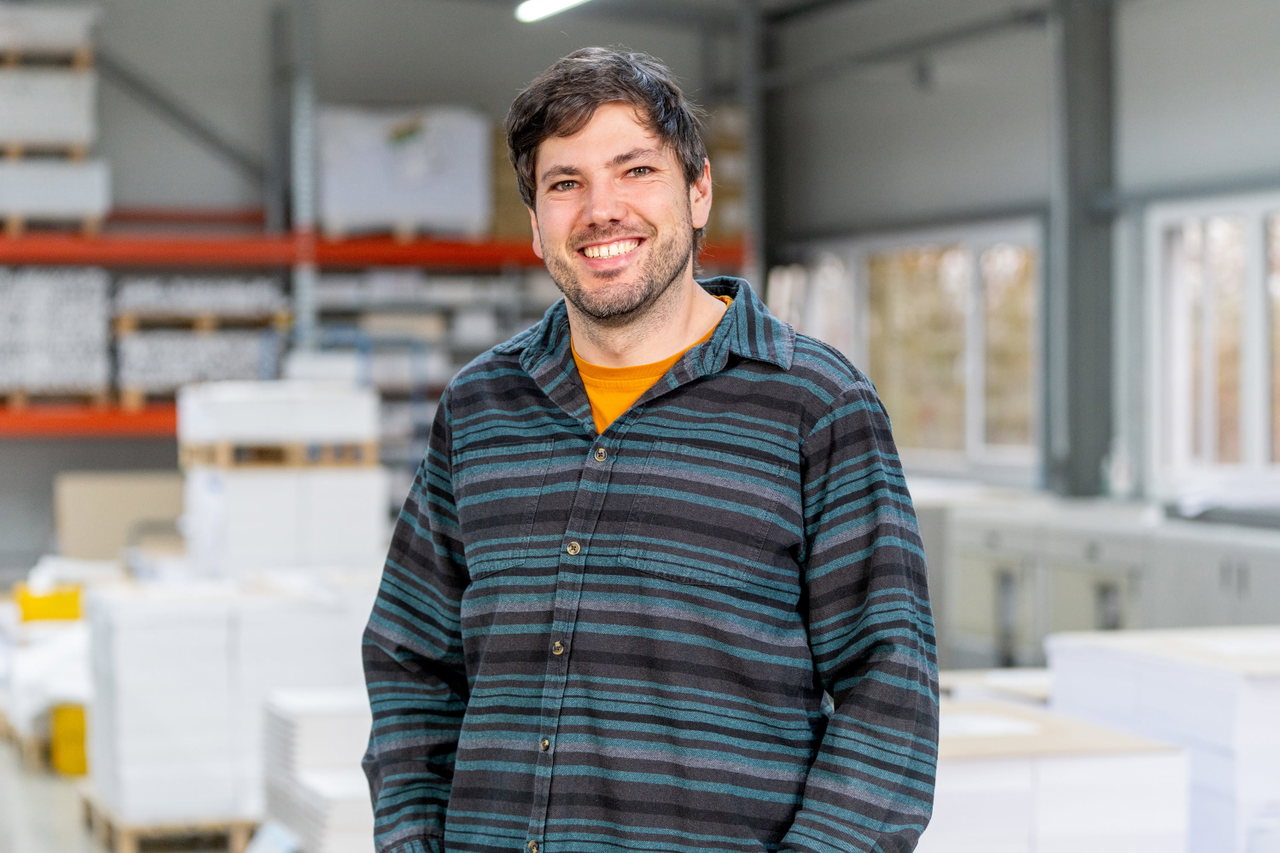
Veit Rudolph is a print shop owner (Rudolph Druck) and publisher based in Schweinfurt. In 2025 he was named “Printer of the Year” and, together with the Verband Druck und Medien Bayern e. V., won the Gold Award of the “Best of Corporate Print” Contest by Content Marketing Forum. He runs V. Rudolph Printing as its owner. His professional background is rooted in a solid foundation in printing and typography.