a book is only the beginning
AI adoption in the book publishing value chain 3: Multi-channel publishing
Most publishers still treat the finished book as the end point – as a product to be pushed onto the market and marketed as effectively as possible. With AI, it makes more sense to view the book additionally as a raw material: as a starting point for many other products and initiatives, claims publishing and AI expert Eric Kubitz, and presents us some surprising and mostly reassuring insights.

Published: 2.9.2026 | Youtube, Eric Kubitz/contentman. Grafiken: Eric Kubitz / Notebook LM.
From marketing to transformation – what publishers really do with liquid content
The difficulty here isn’t the technology, as AI helps with that. The difficulty lies in letting go of the idea that the book is the goal.
There is that moment when a book is finished. The final chapter is in place, the editing is complete and the file goes to production. Everyone breathes a sigh of relief and – I believe – at least since the advent of social media, falls into the same all-too-understandable fallacy: we regard this moment as the end. Yet, with today’s tools, it’s actually more like the beginning.
Just over ten years ago, I had the pleasure of visiting a great many publishers, both large and small. I was invited to speak there about online marketing and search engine optimisation. What has amazed me most whilst writing this article is the fact that – AI or no AI – I have to draw on so many ideas from back then.
The term ‘liquid content’ didn’t exist back then, but it captures quite precisely what a book can also be: strong, well-researched content that exists in a modular form and can be reassembled depending on the channel. The book naturally remains at the centre, but it is no longer the only form in which the content is aggregated – merely the first.
Self-publishers are already leading the way
This article is aimed at people in publishing houses: at the teams currently responsible for production, distribution, metadata and marketing. None of these tasks are going to disappear, certainly not because of AI. After all, all of this is part of the book, just as the book trade is – whether analogue or digital.
Yet self-publishers and small, flexible teams are showing that these same functions can be reorganised: faster, more directly, without the old departmental boundaries. Authors turn their content into compelling social-media channels and newsletters – and the book fits naturally into that ecosystem.
AI hasn’t (yet) changed everything. However, in some areas it enables greater efficiency, thereby freeing up time that can be invested in new products. But then, old organisational structures – which are ill-suited to the kind of profound transformation we are currently experiencing – usually act as a brake.
From AI hype to liquid content
The initial reaction to AI within companies and publishing houses was: cost-cutting. If, thanks to AI, the same number of people can now achieve more results, this means, firstly, that staff numbers can be reduced and, secondly, that more of the same can be churned out onto the market. The quickest to act have acquired technical systems that automatically edit content, assist with layout and automatically create products from successful material.
This has led, in part, to disillusionment: after all, AI models can only simulate human work, not replace it. Those who rush into automation may now find themselves employing the same number of staff to hunt for errors and oversights made by AI. And this applies to even more products, as output has increased.
Admittedly, AI’s performance improves almost weekly, so it will be worth relying on AI support. Just not quite as quickly as some people thought.
What is certainly worthwhile is familiarising oneself with how LLMs (Large Language Models) work: they absorb as much text content as they can find, break it down into its semantic (content-related) parts (known as ‘chunks’) and position these within a multidimensional knowledge space – from which the appropriate words, sentences and content are then generated.
As a result, the models have learnt to handle language and the knowledge they’ve absorbed. However, they do so in a very general way, as they’ve essentially taken in virtually all available texts.
Publishers can apply this in a more focused way based on their own products. This is known as ‘Liquid Content’.
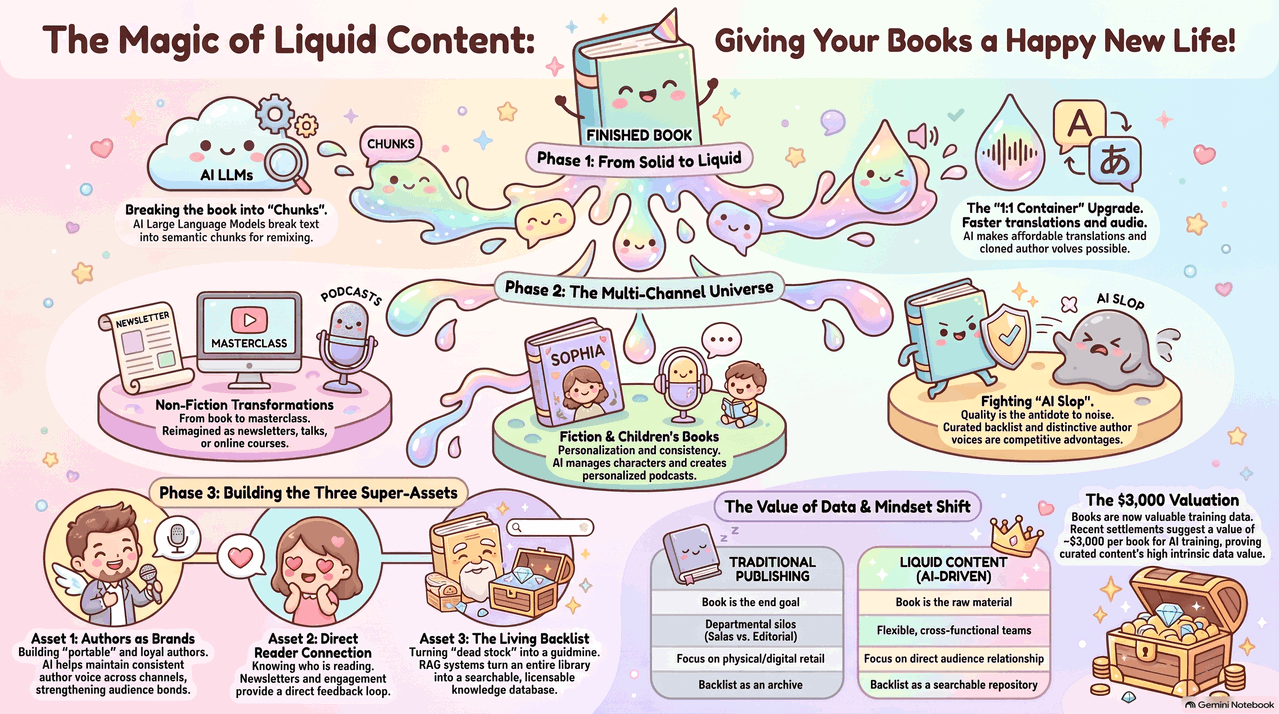
Liquid content, the playful version — created with Google's NotebookLM from this article.
Liquid content flows into new channels
For content to become this ‘fluid’, it must first be broken down. It’s a bit like ‘sampling’ in music: you take a finished piece, break it down, remix the elements and create new music from them. And it’s not just the big LLMs that can do this – publishers can do the same with their content. Good AI tools can do this with a book, if you let them.
Naturally, this is easier and makes more sense with specialist, non-fiction and self-help literature. Fiction is only of limited suitability for this process.
For suitable published works, Liquid Content can certainly do what liquid does: flow into small corners and areas that a book has not previously been able to reach.
A simple starting point is the 1:1 container: the same work in a different format. Print, e-book, audiobook – and above all, translations. The latter in particular were long an expensive option in the publishing business; today, they are suddenly accessible even for smaller catalogues. Admittedly, with some compromises on quality. And yet: publishing an important non-fiction book in, say, Hungarian at minimal additional cost can be worthwhile.
Audiobooks follow a similar path: AI can not only translate a book but also have it read aloud in the author’s cloned voice – in languages they do not even speak themselves. For the original version of a novel, I would advise authors to go into the studio themselves or work with professional narrators. However, when it comes to non-fiction content, it may well be that synthetic voices are sufficient to appear in search results on Audible, which is now a major platform. It’s certainly worth experimenting with this, as the quality improves every month.
Working in a maze of ambiguities
AI adoption in the book publishing value chain 1: writing and authoring

Testing new products with liquid content
And then there are the genuine derivatives – new products based on familiar material. A non-fiction book becomes a newsletter, a series of talks or even an online course. A children’s book becomes a podcast series, possibly even personalised with the child’s name. A personalised Toniebox without the box ;-)
And a novel becomes a series, with its characters and world consistently managed by AI, so that in the third volume nobody suddenly has the wrong eye colour. ‘One book, many formats becomes ‘one book, many products’.
As I write these sentences, I can sense how an inner resistance to all this will build up among readers. After all, we’re employees of a publishing house, not lecture event managers or online course leaders. This objection is valid; we’re not there yet. But: are others already more flexible?
The new bottleneck isn't production
Let’s assume, for the sake of argument, that publishing staff are flexible. Then there’s perhaps an even bigger problem to tackle: discoverability.
Used poorly, AI multiplies one thing above all else: mediocre reach, which obscures the audience’s view of the really good stuff. The term for this is ‘AI slop’, which we see every day (not only) on LinkedIn and read in AI-generated synopses, concepts and emails.
Yet, of all things, publishers have an antidote for this: our raw material remains our distinctive voice, the quality work – curated in an outstanding backlist.
A well-maintained backlist, clean, AI-supported metadata and in-depth knowledge of readers aren’t just a matter of hard work; they’re what could make a good work visible in the first place amidst the AI-slop noise. Anyone can spout general AI drivel these days, but only publishers can offer a deep dive into a topic with the distinctive voice of real authors.
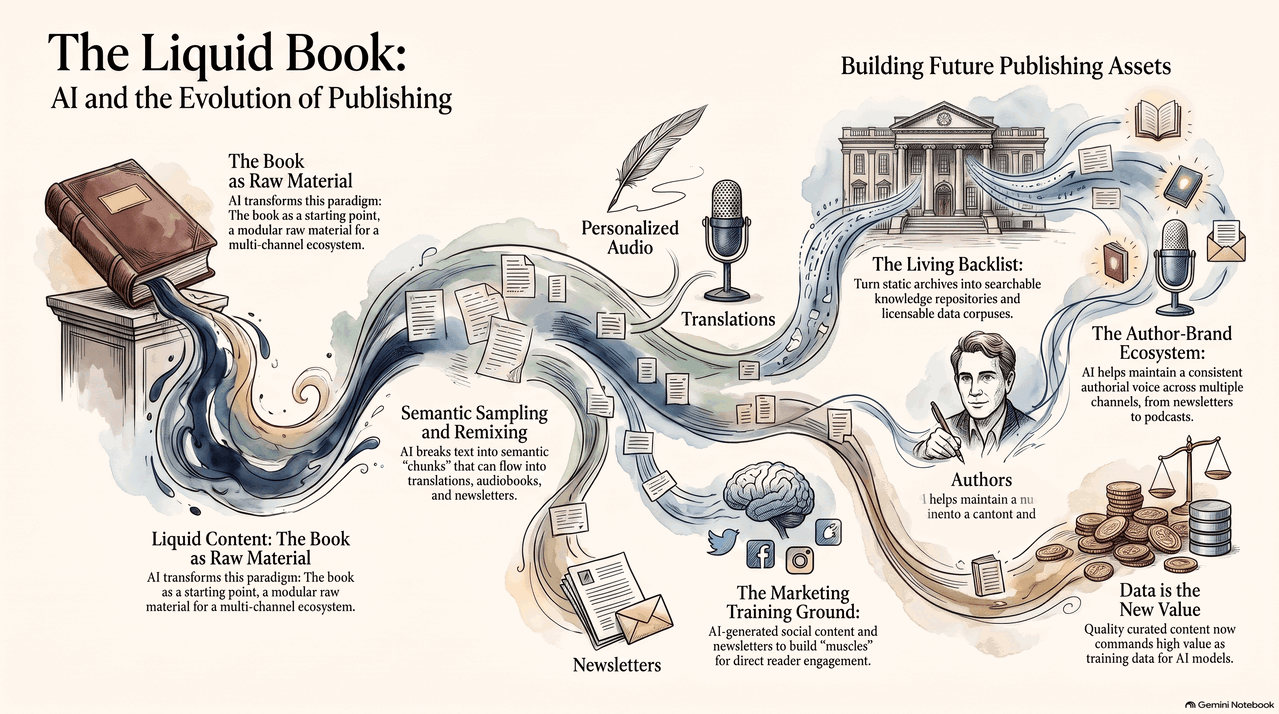
AI-generated from this article with Google's NotebookLM — beautiful at a glance, but look closely and the garbled words show where the tools still fall short.
Start with marketing
I know that for most publishers, all this is quite a tall order: rights, systems, established practices – everything has to be taken into account. The trick is to start small. And the best place to practise this is in marketing.
Why start with marketing when it comes to liquid content? Because it’s low-threshold, because it’s reversible, and because we can get started straight away without having to overhaul half the organisation. High-quality, content-rich social media posts, short videos with real depth – these are much easier to produce with AI today than they were just a few months ago. That’s because almost any AI tool can read the contents of a book and turn good quotes from it into digital artefacts that are worth reading and watching.
If you want to see the possibilities for yourself, try uploading a book to an AI tool with an audio function and have it generate an audio summary. After that – and I promise you this – creative product ideas will just start flowing. Data protection concerns? This also works with books that have long since been taken out of print.
Back to marketing: does every book need its own Instagram channel? I don’t know, but it’s easier to achieve today. Good, up-to-date quotes paired with good image ideas or graphics generated from an image model can be produced quickly. And in the process, we’re learning what self-publishers have long been able to do: establish direct contact with the target audience. Publishers are used to dealing with physical and digital retailers. Direct communication with readers is something many publishers are unfamiliar with.
An important learning objective in marketing is not to churn out as much trivial content as possible, as quickly and automatically as possible. Instagram, TikTok and LinkedIn are places where you learn to create AI-generated content in such a way that it doesn’t sound like rubbish, fits the platform, and allows you to get a direct sense of what the target audience is saying about it. These are skills best learnt in an environment where a single misstep doesn’t immediately damage the whole project.
My favourite example of sustainable book marketing is the newsletter that starts before the book is even finished. Publishers or authors use it to build an audience whilst the content is still being created – not just once it’s on the shelves and they have to rush to promote it. Once you’ve trained these ‘muscles’, the bigger steps come more easily later on. Because you’ll need exactly the same ‘muscles’ – conveying a voice across channels, maintaining a direct relationship with the audience, thinking of content in building blocks – for whatever the future may bring.
And, yes, I know: it’s not the marketing department that writes a themed newsletter, and it’s not the editorial team that maintains contact with the audience. At least, not yet.
When AI works best as a second pair of eyes
AI adoption in the book publishing value chain 2: Editing
Three assets (yet to be developed)
Anyone who has entered the world of marketing as a training ground can start to think on a larger scale. Until now, publishers have primarily operated on the basis of two things: their catalogue and their distribution channels to bookshops. Both remain important. But they can be supplemented. Here are three additional assets that were already a topic of discussion ten years ago:
Authors as a brand
The first asset is the authors themselves. AI helps to convey their voice and perspective consistently across many channels – from their own voice when reading aloud to a newsletter that truly sounds like them and not like a machine.
And that was the most frequently cited obstacle during my time as a publishing consultant back then: a strong author brand makes authors ‘portable’. It was said that anyone who has their own direct relationship with their audience is easier to poach, or will eventually no longer need the publisher. It sounds plausible, but is that really the case? Does the publisher build up its authors’ brands so that they can then go off and do their own thing? Or is it more of an investment in the publisher’s own thematic brand? And if that’s done well, don’t authors actually feel a stronger sense of loyalty?
The connection with the audience
The second asset is the direct relationship with readers – something that can develop, for example, from a newsletter. Publishers have traditionally shunned this connection or treated it as an afterthought, for an understandable reason: they deal with bookshops and platforms, not with the end customer. Anyone who sells directly risks falling out with the very partners on whom they depend.
This channel conflict is not easy to resolve. Yet the direct relationship with readers is a treasure you cannot find anywhere else: loyalty. Anyone who knows who is reading their books, why they do it, and what they’ll read next has a direct feedback loop into programme planning – and this, too, is an asset. Perhaps the strategic question isn’t ‘Direct sales: yes or no?’, but rather: ‘How much direct engagement can I risk without alienating the retail sector?’
The tough nut to crack: the backlist
And then there’s the third asset – perhaps the most exciting one. Imagine a publisher throwing all its gardening books into a shared, searchable knowledge repository – the techies call this a RAG system. A backlist that previously appeared as dead stock on the balance sheet suddenly becomes a living, searchable, licensable corpus. No longer fifty individual titles, but a single vast body of gardening knowledge that can be offered as a database, as an assistant, or as a new product.
This is precisely where a publisher has something that an individual self-publisher will never have: a vast amount of its own, curated, reliable content. Anyone who views the backlist as a reservoir of raw material rather than an archive opens up a business opportunity that goes far beyond the sale of individual books.
The major catch, of course, is a legal one: do the authors’ contracts permit this pooling? And if the content reservoir generates revenue, who else stands to benefit? This is a crucial question for the coming years. I suggest we address it now rather than later.
Data is finally being recognised as having value
Because something happened recently that confirms this: until now, books have been an unpaid afterthought for the AI industry – training material that was taken without asking. And that is precisely what is changing right now. In the US, a settlement has been confirmed under which the AI provider Anthropic must pay around 1.5 billion US dollars – roughly 3,000 US dollars per book. For many authors, that’s more than they would earn from over-the-counter sales.
So the good news is this: works that are disparagingly referred to as ‘content’ are finally being recognised as having intrinsic value in their own right as data. If a book is worth US$3,000 to an all-powerful AI company, what is that book worth ‘internally’ as liquid content within the catalogue?
I know there are technical, organisational and legal obstacles for publishers on this path. But anyone who, starting today, manages their authors’ rights with this in mind is building up an asset – and may even retain them at the publishing house for longer.
Ultimately, I hope this will even help combat the ‘slop’. If good, curated works are given a measurable value and stand out from mass-produced machine-generated content, then quality will be worthwhile again – even in areas where, until now, only quantity counted.
The book was just a beginning."

Eric Kubitz Eric Kubitz is Head of AI at the German publishing house Wort & Bild Verlag, where he develops strategies for the use of artificial intelligence in editorial work. For 25 years, he has worked at the intersection of technology, content and creativity – always with the goal of creating digital media products with real value. You can meet him at the relevant industry conferences and on his blog, Contentman.