when ai works best as a second pair of eyes
AI adoption in the book publishing value chain 2: Editing
An editor’s working day still contains a paradox that has barely changed since manuscripts moved from paper to Word: the smallest details demand intense attention, while the largest errors often hide in plain sight. A repeated image 200 pages later, a character whose timeline no longer adds up, a term that quietly changes spelling: these become harder to see the longer one stares at a book. AI promises relief, and software vendors are increasingly packaging that promise into subscriptions, team licences and manuscript-analysis credits. But the interesting question for publishers is not whether machines can find mistakes. It is what happens to editorial work when they can.
This article forms part two of a series on AI adoption in the book publishing value chain from authoring (Part 1) to marketing.

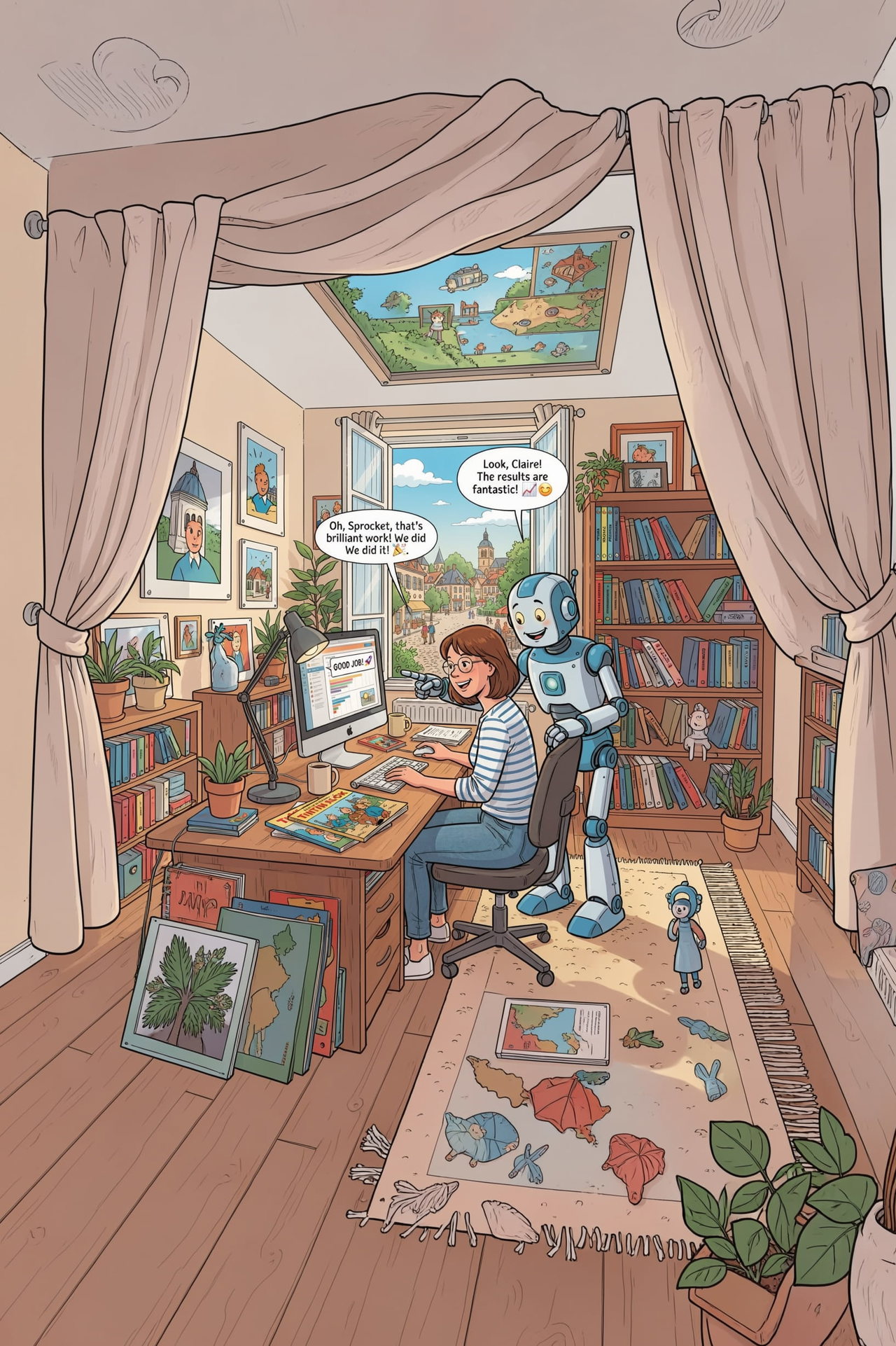
Published: 30.8.2026 | Image: Magnific AI.
There is a reason copy editing has traditionally rewarded patience rather than glamour. Professional standards define the task not merely as correcting spelling and punctuation, but as ensuring consistency, accuracy, terminology and logic. In book publishing, however, some of the problems editors worry about – plot coherence, argument structure, repeated ideas or pacing – already edge into structural or developmental editing. That distinction matters because AI tools increasingly blur it.
Players in the field and their scopes and limitations
The first wave of digital editing software largely automated bounded tasks. PerfectIt, for example, concentrates on consistency and house-style enforcement: abbreviations, hyphenation, capitalisation, spelling variants and other repeatable rules. TextShine leaves the wording intact but offers a deep integration in a broad variety of text processing and editorial systems. LanguageTool combines conventional grammar and style checking with AI-based rewriting. Grammarly has moved from error detection toward full-sentence rewrites, tone control, brand rules and generative assistance. ProWritingAid goes furthest toward the book manuscript itself, offering more than 25 analysis reports as well as chapter critique and paid whole-manuscript services covering areas such as plot, virtual beta-reader feedback and marketability.
This is where AI can genuinely improve an editor’s working conditions. A machine does not get bored by the 137th occurrence of an overused phrase. It can compare terminology across chapters, generate a list of recurring stylistic patterns, flag passages that deserve a second look and run the same house-style rule thousands of times. Used well, it shifts scarce human attention away from mechanical detection and toward judgement.
But “used well” is doing a lot of work. Large language models can accept very long inputs, yet long context does not guarantee reliable attention. Research found that model performance can deteriorate when relevant information sits in the middle of a long context. It also cautions that techniques designed to improve long-context processing do not generalise equally well across tasks.
For a 100,000-word manuscript, therefore, “upload the book and ask the AI to find inconsistencies” is not an editorial method. A better workflow divides the text into controllable units, extracts structured facts and editorial decisions, compares them across the manuscript and then puts a human editor back in charge of the whole. Ironically, one of AI’s greatest promises for long-form editing – never losing sight of the whole book – is also an area where it still needs careful supervision.
Working in a maze of ambiguities
AI adoption in the book publishing value chain 1: writing and authoring

Freemium at the front, enterprise at the back
Some vendors have found a business model that fits this hybrid role remarkably well. At the consumer end, freemium products create enormous funnels. Grammarly says it is used by more than 40 million people and 50,000 organisations. Its Pro product is subscription-based, while enterprise functionality is now tied into the wider Superhuman product suite which offers AI agents for a variety of tasks including, of course, editorial ones.
ProWritingAid boasts with clients like wattpad, ElevenLabs or lulu.com, claiming its ecosystem reaches more than four million writers. It combines free access with monthly, annual and lifetime plans; computationally more demanding manuscript functions are additionally monetised through “Story Credits.” That is an interesting model for publishing technology: recurring SaaS revenue for everyday use, complemented by consumption-based charging when users submit entire books for deeper analysis.
LanguageTool reports more than two million active browser-extension installations and more than 20 million texts improved per day. Its commercial ladder leads from a free product toward Premium and team plans, with longer text limits, unlimited AI paraphrasing, dictionaries and shared style guides.
PerfectIt follows a narrower professional strategy. Its subscription model extends into team and enterprise packages built around deployment, training and centrally managed style rules.
This combination – free acquisition, recurring subscription revenue, team expansion and paid high-compute functions – helps explain the attractiveness of the category. It also suggests something important for publishers: the strongest editing products need not be those that replace editors most convincingly. They may be those that become most deeply embedded in an editor’s workflow.
The uncomfortable part of the bargain
The ethical problem begins where convenience obscures provenance. Manuscripts are unpublished intellectual property; editorial systems can also contain confidential commercial information. Yet the 2025 BISG/BookNet Canada survey of more than 550 North American book-industry professionals found that only 27 percent of organisations used closed or enterprise AI environments and fewer than 30 percent had formal AI-governance policies. At the same time, 98 percent of respondents reported at least one concern. Copyright led the list at 86 percent, followed closely by hallucinations at 84 percent. For publishers, procurement policy is therefore becoming part of editorial policy.
Authors’ positions are ambiguous. Whilst the concern of authors’ organisations with respect to copyrighted texts being used to train Large Language Models is unanimous, open or (even more so) tacit individual use of AI tools is widespread, making the business a potential minefield and blowing up promising book projects at a monthly rate.
What it all means for editors
For editorial departments, the practical conclusion is less dramatic than either evangelists or sceptics might prefer. AI is already good enough to deserve a place in the workflow, but not good enough to deserve the final word. Wise publishers will deploy it first where the result is inspectable: consistency checks, repetition reports, terminology, styleguide enforcement, comparison and triage. Generative rewriting deserves a higher threshold, especially when authorial voice is at stake.
The editor’s role may therefore become more demanding, not less. Someone still has to decide whether repetition is clumsy or deliberate, whether an inconsistency is an error or a clue, whether a smoother sentence is actually a worse sentence and whether a proposed correction quietly changes the author’s meaning.
The machine can scan the forest faster than any human. The commercial and editorial advantage will go to publishers that remember why they still need someone who knows which trees matter.

Michael Lemster (LinkedIn profile) is a specialist journalist and author focusing on media, publishing, and cultural topics. He writes about the digital transformation of the publishing industry, editorial practices, and the intersections of technology, content, and the market. As a book author, he has published cultural-historical family biographies on the Mozarts, the Brothers Grimm, and the Strauss and Wagner families.